Could Everyday Chemicals Be Affecting Your Hormones and Fertility?
Jul 14, 2026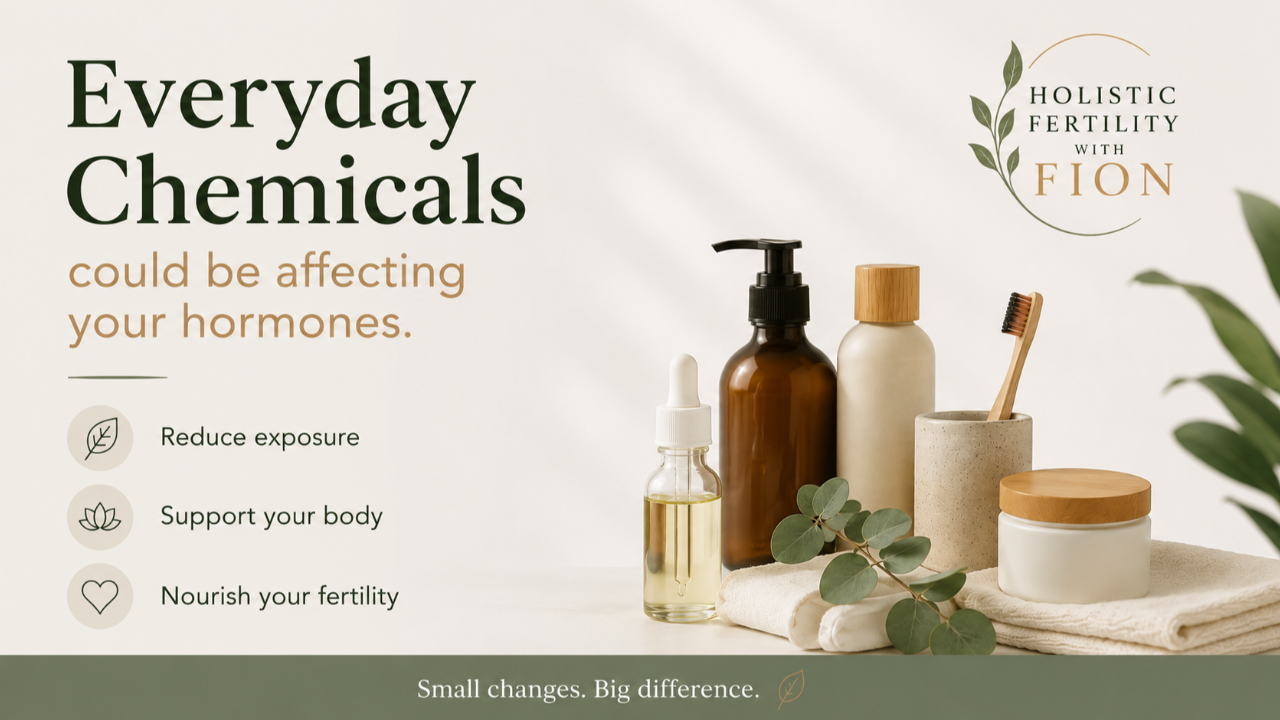
When we think about improving fertility, we often focus on diet, supplements, exercise and tracking ovulation.
But have you ever thought about the products you use every single day?
Your shampoo. Body wash. Make-up. Perfume. Sunscreen. Food containers. Clothing. Even your underwear.
Some everyday products may contain chemicals that can interact with our hormonal system. These are often called endocrine-disrupting chemicals, or EDCs.
This doesn't mean you need to panic, throw everything away or try to live a completely “chemical-free” life. That is neither realistic nor necessary.
But understanding where these chemicals may come from—and making a few simple changes—can be another practical way to support your hormonal and reproductive health.
What are endocrine-disrupting chemicals?
Our endocrine system is the body's hormone communication network.
Hormones act like chemical messengers. They help regulate our menstrual cycle, ovulation, egg development, metabolism, thyroid function, stress response, implantation and pregnancy.
Endocrine-disrupting chemicals are substances that may interfere with this hormonal communication.
Depending on the chemical, they may mimic the action of a natural hormone, block hormone receptors, or influence how hormones are produced, transported or broken down.
This is particularly interesting in fertility because our reproductive system relies on very carefully coordinated hormonal signals.
FSH helps stimulate follicle development. LH is involved in ovulation. Oestrogen supports follicular development and the uterine lining. Progesterone supports the luteal phase and prepares the uterus for implantation.
Our hormones work together as a complex network.
Research is continuing to investigate how long-term exposure to certain environmental chemicals may influence reproductive health. Higher exposure to some EDCs has been associated with changes in ovarian function, ovarian reserve, menstrual health and fertility outcomes.
It is important to understand that an association does not automatically mean that a chemical directly caused a fertility problem.
Fertility is multifactorial.
Age, genetics, medical conditions, sperm health, nutrition, metabolic health, stress, sleep and many other factors can all play a role.
My approach is therefore not about creating fear. It is about reducing unnecessary exposure where it is practical to do so.
Which chemicals are commonly discussed?
There are several groups of chemicals that are frequently studied in relation to hormones and reproductive health.
Phthalates
Phthalates are used in many consumer products and may be found in plastics, fragrances and some personal care products.
Potential sources include perfume, fragranced body lotions, shampoo, cosmetics, nail products, air fresheners and food packaging.
Research has explored the relationship between phthalate exposure and reproductive hormones, ovarian function and fertility outcomes.
One very simple change is to reduce the number of heavily fragranced products you use every day.
You don't necessarily need five different scented products on your body before you leave the house!
A fragranced shower gel, shampoo, conditioner, body cream, deodorant and perfume can all contribute to our overall daily exposure.
Choosing simpler or fragrance-free products for some of these can be a practical starting point.
Parabens
Parabens are preservatives used to help prevent bacterial and fungal growth in cosmetic and personal care products.
You may see ingredients such as methylparaben, propylparaben or butylparaben on product labels.
Some parabens have weak oestrogen-like activity, which is why researchers are interested in their potential endocrine effects.
Again, this does not mean that using one product containing parabens will suddenly disrupt your fertility.
The question is more about repeated and combined exposure over time.
If you are replacing your shampoo, body lotion or cosmetics anyway, you may wish to choose a simpler product or a paraben-free alternative.
There is no need to throw away your entire bathroom cabinet tonight!
BPA and plastics
Bisphenol A, commonly known as BPA, has been widely studied because of its potential endocrine activity.
BPA has historically been used in some plastics and food-contact materials.
Research has investigated possible associations between BPA exposure and ovarian function, egg development, insulin resistance and reproductive outcomes.
One of the easiest changes I recommend is:
Avoid heating food in plastic containers whenever possible.
Heat may increase the movement of some substances from food packaging into food.
Instead, you can transfer your food to a glass or ceramic container before microwaving it.
I also prefer glass containers for storing hot foods where practical.
Small change. Very little inconvenience.
PFAS—the “forever chemicals”
PFAS are a large group of chemicals used because they can resist water, grease and stains.
They are sometimes called “forever chemicals” because some PFAS break down extremely slowly and can persist in the environment.
They have been used in some waterproof products, stain-resistant materials, food packaging and certain textiles.
This is one reason I encourage women to think about their clothing—not just their skincare.
Highly functional clothing may be marketed as waterproof, stain-resistant, quick-drying or highly technical.
Of course, sometimes we genuinely need these functions.
But do we need them for everything we wear every day?
For underwear, I usually suggest choosing simple, breathable cotton where possible. Organic cotton may also be an option if it is affordable and accessible to you.
I also recommend washing new clothing before wearing it.
Again, the aim is not perfection.
It is simply asking: Do I need this additional chemical treatment for this particular product?
What about make-up and cosmetics?
Many women use multiple products on their skin every morning.
Cleanser.
Toner.
Serum.
Moisturiser.
Primer.
Foundation.
Concealer.
Blusher.
Lip products.
Perfume.
The issue is not necessarily one individual product.
Researchers are increasingly interested in our combined exposure from multiple sources.
My practical advice is to simplify.
When a product runs out, look at the ingredients before replacing it.
You may wish to choose products that are fragrance-free or formulated without certain commonly discussed endocrine-disrupting chemicals.
You don't need to replace everything at once.
Change products gradually.
This is much more affordable and much less stressful.
Perfume and fragranced products
I know many women love perfume—and I am not here to tell you that you can never wear perfume again!
But fragrance products are another area where phthalate exposure has been discussed.
My suggestion is simply to think about how much fragrance you use.
Do you need scented shampoo, shower gel, body lotion, deodorant, laundry products, air freshener and perfume all at the same time?
Reducing some unnecessary fragranced products can lower your overall exposure without making a dramatic change to your life.
Sunscreen and hormone health
Some chemical UV filters, including oxybenzone and octinoxate, have been investigated for possible endocrine activity.
However, this is an area where we need a balanced discussion.
Excessive UV exposure can damage the skin and increase skin cancer risk.
Therefore, I do not recommend simply stopping sunscreen.
Instead, I encourage women to use sun protection wisely.
Think about physical protection too: shade, hats, appropriate clothing and long sleeves.
Some people may also prefer mineral sunscreens containing zinc oxide or titanium dioxide.
I am also cautious about spray sunscreens, particularly because of the possibility of inhaling the product.
Sun exposure is also relevant to vitamin D, which plays an important role in immune and reproductive health.
However, this does not mean deliberately burning your skin or spending prolonged periods in strong sunlight without protection.
The goal is always balance.
Why may this be particularly relevant for PCOS?
PCOS is not simply a problem with the ovaries.
For many women, it involves a complex interaction between hormones, insulin resistance, inflammation and metabolism.
Some research has investigated whether endocrine-disrupting chemicals such as BPA and phthalates may interact with metabolic and hormonal pathways relevant to PCOS.
This does not mean chemicals “cause” every case of PCOS.
But if a woman already has insulin resistance or hormonal dysregulation, reducing unnecessary environmental exposures may be a sensible part of a wider lifestyle strategy.
Nutrition, exercise, sleep, weight management where appropriate and medical treatment remain extremely important.
What about endometriosis?
Endometriosis is also a complex condition.
It involves inflammatory, hormonal and immune processes.
Because endometriosis is oestrogen-responsive, researchers have been particularly interested in environmental chemicals that may interact with oestrogen pathways.
Studies have investigated BPA, phthalates, PFAS and other environmental pollutants in relation to endometriosis.
The research is still developing and we cannot say that one particular shampoo or plastic container causes endometriosis.
But from a holistic perspective, I believe reducing unnecessary exposure can form part of an overall anti-inflammatory and hormone-supportive lifestyle.
Can environmental chemicals affect ovarian reserve?
This is an important question, particularly for women with low AMH or diminished ovarian reserve.
Age remains the strongest and most established factor affecting ovarian reserve and egg quality.
We cannot reverse ovarian ageing simply by changing our shampoo or buying glass food containers.
However, research has found associations between exposure to some PFAS, phthalates and other endocrine-disrupting chemicals and markers of ovarian ageing or ovarian reserve.
My approach is to focus on the factors we can influence.
We cannot change our age.
We cannot change our genetics.
But we can look at nutrition, smoking, alcohol, sleep, stress, metabolic health and unnecessary environmental exposures.
I call this optimising the environment around the egg.
Stress is also affecting your hormonal system
When we talk about “hormone disruptors”, we shouldn't focus only on chemicals.
Chronic stress can influence the nervous, endocrine and immune systems.
The hypothalamus and pituitary gland play a central role in reproductive hormone signalling.
At the same time, our stress response involves the hypothalamic-pituitary-adrenal—or HPA—axis.
These systems do not work completely independently.
Long-term stress may influence sleep, insulin sensitivity, inflammation, appetite and reproductive hormone signalling.
This does not mean that stress is the reason you are not pregnant.
Please don't add “I must stop being stressed” to your fertility worry list!
Instead, I encourage women to actively support their nervous system.
Gentle exercise, breathing exercises, meditation, acupuncture, spending time outdoors and improving sleep can all be useful.
The aim is not to eliminate stress.
It is to improve how your body recovers from stress.
What nutrients can support hormonal and reproductive health?
Two nutrients I commonly discuss with fertility clients are omega-3 fatty acids and vitamin D.
Omega-3 fatty acids, including EPA and DHA, are involved in cell membrane function and inflammatory pathways.
Good dietary sources include oily fish such as salmon, sardines and mackerel.
For women who do not eat fish, algae-derived omega-3 may be an alternative.
Vitamin D is also particularly important.
Vitamin D receptors are found in reproductive tissues and immune cells, and vitamin D is involved in immune regulation and many metabolic processes.
In the UK, vitamin D insufficiency is common, particularly during autumn and winter.
If you are trying to conceive and are concerned about your vitamin D status, it may be worth discussing testing and appropriate supplementation with your GP or healthcare professional.
Supplements should always be individualised. More is not always better.
Where should you start?
If you are reading this and suddenly thinking, “Everything in my house is toxic!”, that is not the message I want you to take away.
Start small.
You could choose just three changes this month:
-
Stop heating food in plastic containers.
-
Choose cotton underwear and wash new clothes before wearing.
-
Replace one heavily fragranced personal care product with a simpler alternative.
Next month, look at something else.
Perhaps your cosmetics.
Perhaps your food storage.
Perhaps your sunscreen.
Perhaps your household fragrance products.
Small changes are much more sustainable than trying to create a perfect, toxin-free life.
My final message
Fertility is complex.
There is rarely one single reason why a woman struggles to conceive.
Environmental chemicals are only one part of a much bigger picture involving age, egg and sperm health, hormones, metabolic health, inflammation, immune function, nutrition, sleep and emotional wellbeing.
My philosophy is not about fear.
It is about understanding your body and making informed, realistic choices.
You don't need to be perfect.
You don't need to throw everything away.
You simply need to ask:
“Is there a simple change I can make today to create a healthier environment for my hormones and fertility?”
Sometimes, the smallest changes are the easiest ones to maintain. 🌿
Fion Lam
Fertility Coach | Fertility Acupuncturist & Herbalist | Registered Nurse
Author