Fertility Is More Than Just Getting Pregnant
Jul 11, 2026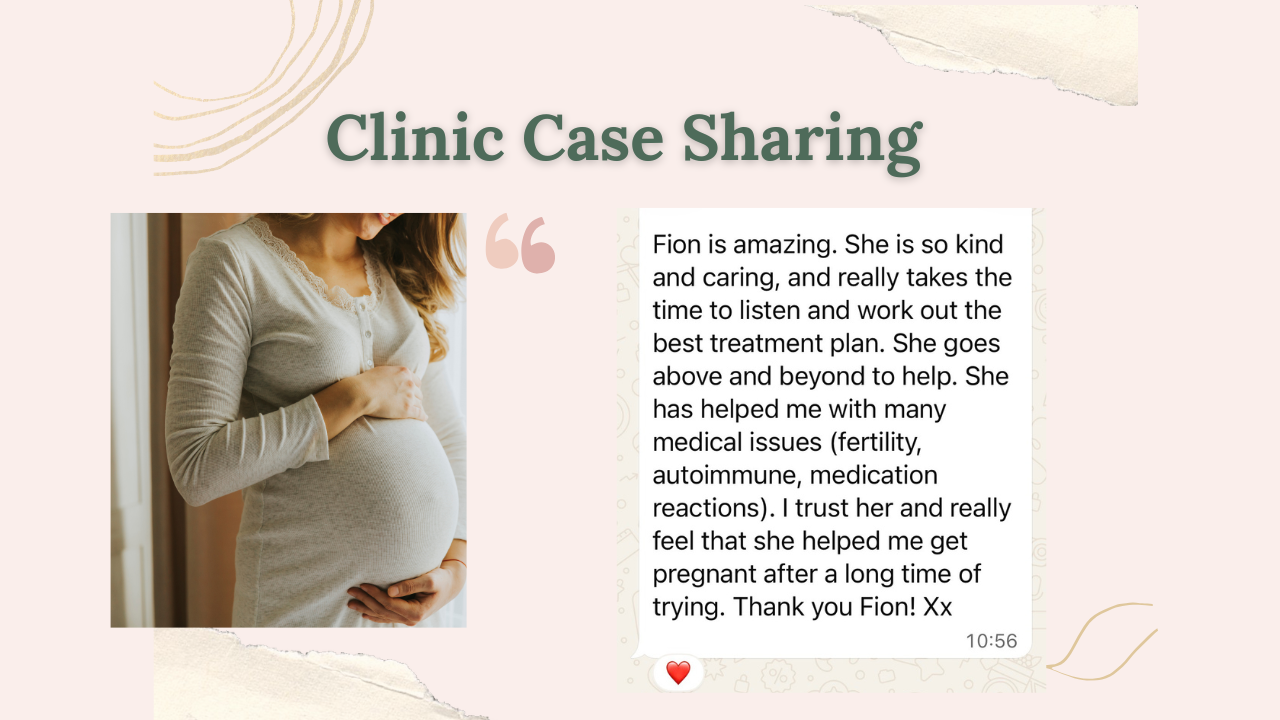
Recently, I received a lovely testimonial from one of my fertility clients:
“Fion is amazing. She is so kind and caring, and really takes the time to listen and work out the best treatment plan. She goes above and beyond to help. She has helped me with many medical issues (fertility, autoimmune, medication reactions). I trust her and really feel that she helped me get pregnant after a long time of trying. Thank you Fion! Xx”
Reading this meant so much to me.
Of course, I would never say that one treatment alone “made” someone pregnant. Fertility is complex, and pregnancy depends on many different factors.
But her words reflect something that is central to the way I work: fertility care should look at the whole person, not just the reproductive system.
Fertility Is Rarely Just About the Ovaries
When someone comes to see me for fertility support, I don't only ask when their last period started or when they ovulate.
I look at the menstrual cycle in detail — cycle length, flow, blood colour, clotting, period pain, spotting and ovulation signs — but I also want to understand what is happening elsewhere in the body.
How are you sleeping? How is your digestion? Are you exhausted? Do you feel cold? How are you coping with stress? Have your symptoms changed since starting fertility medication?
These details matter.
The reproductive system does not work in isolation. Hormones, the nervous system, immune health, metabolism, circulation and general wellbeing are all interconnected.
That is why fertility support should be individualised.
There Is No Standard Fertility Acupuncture Treatment
One common misconception is that fertility acupuncture involves a standard set of “fertility points”.
That isn't how I work.
Treatment may change depending on whether you are menstruating, approaching ovulation, in the luteal phase, undergoing IVF stimulation, preparing for embryo transfer or in the two-week wait.
Even two women at exactly the same stage of IVF may need very different support.
One may be exhausted and sleeping poorly. Another may have bloating, headaches or constipation. Someone else may have PCOS, endometriosis, adenomyosis or a history of pregnancy loss.
I treat the person in front of me, not simply the fertility diagnosis.
Combining Nursing and Traditional Chinese Medicine
My approach is shaped by both my background as a Registered Nurse and my training in acupuncture and Chinese herbal medicine.
I want to understand your diagnosis, blood tests, medications and fertility treatment protocol. But I also use Traditional Chinese Medicine assessment, including the menstrual cycle, tongue, pulse, sleep, digestion, energy and other patterns in the body.
These approaches do not need to compete.
My role is not to replace your GP or fertility specialist, but to provide individualised complementary support alongside appropriate medical care.
Trust Matters
The part of this testimonial that touched me most was simply:
“I trust her.”
Fertility can be an incredibly vulnerable journey. Clients may be dealing with miscarriage, unsuccessful treatment, concerns about age, relationship stress, the financial pressure of IVF, or the monthly disappointment of another period.
I cannot promise that acupuncture or Chinese medicine will result in pregnancy.
What I can do is listen carefully, assess the bigger picture, explain my clinical thinking, adapt treatment as circumstances change and recommend medical investigation when something falls outside my scope.
For me, that is what responsible holistic fertility care means.
Fion Lam
Fertility Support Expert | Fertility Acupuncturist & Herbalist | Registered Nurse
What Is Your Period Telling You?
Want to understand your own cycle more clearly? Try my free interactive Period Health Symptom Tracker to explore your period and symptoms, spot patterns, and discover what your body may be telling you.
Acupuncture and Chinese medicine are complementary approaches and should not replace appropriate medical assessment or fertility treatment. Individual responses to treatment vary, and pregnancy cannot be guaranteed.
Author